ILLUSIONS
It is no secret that ego and politics exist inside organisations. They are not confined to senior leadership. They are present at every level. Middle managers, team leads, specialists, even junior staff all operate within systems where perception, influence, and self-preservation matter.
Politics is often about survival.
Ego is, simply, about ego.
Together, they rarely appear in isolation. They operate quietly in the background of decisions, conversations, and reports. And more often than we admit, they sit behind failures, bottlenecks, and missed signals. Not because people are inherently flawed, but because organisations are human systems.
And human systems distort reality.
The Real Problem Is Not Lack of Information
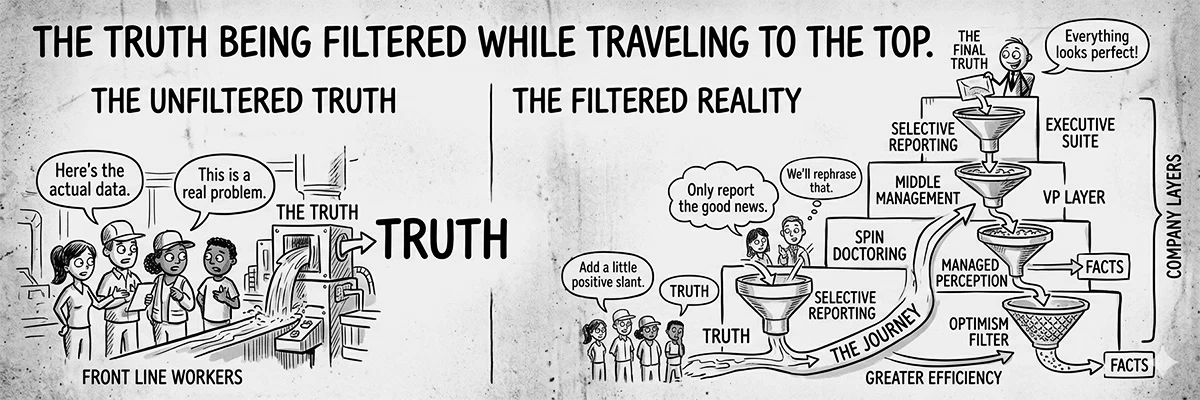
Most organisations do not suffer from a lack of data. They suffer from something far more subtle. Truth becomes inconvenient. And when truth becomes inconvenient, it does not disappear. It gets filtered. Adjusted. Reframed. Delayed. Sometimes quietly rewritten.
The idea that leadership always sees reality clearly is comforting. It is also rarely accurate. Information moves through layers. And at each layer, it is subject to pressure:
- pressure to perform
- pressure to align with expectations
- pressure to avoid blame
- pressure to please
The result is not necessarily a lie. It is something more dangerous: a modified version of reality that feels acceptable.
I once witnessed a conversation between a client and a researcher. The client questioned the figures in a report. The response was calm: “Tell me what the figures should look like. We will rewrite it.”
No conflict. No escalation. Just quiet alignment with expectation. In that moment, the data stopped describing reality. It started serving it.
When Two Realities Emerge
Once data is adjusted, a second reality begins to form. One exists in the field. The other exists in reports, dashboards, and presentations.
At first, the gap is small, but over time, it widens. Eventually, organisations find themselves making decisions based on a version of reality that no longer exists. This is where systems begin to drift. Sometimes the gap is caught early and corrected without major damage. Sometimes it is not. When the two realities finally converge, the correction can be abrupt and costly.
The Meeting Before the Meeting
Many decisions in organisations are not made in formal settings. They are shaped beforehand. Informal conversations. Alliances. Quiet negotiations. By the time the official meeting takes place, the outcome is often already decided. The meeting becomes a performance. A confirmation, not a discussion. People leave with the sense that something has happened. In reality, very little has changed.
This is not entirely irrational. Informal alignment is often faster and more efficient, but when overused, it turns formal structures into theatre, and theatre consumes time and resources while creating only the illusion of participation.
Not all meetings are useless. Some are necessary, but many involve more people than required, for longer than needed, with less impact than assumed. A good manager knows how to be selective.
When Competence Becomes a Threat
Competence is not always welcomed. It can be disruptive. A highly capable person can expose inefficiencies, challenge assumptions, and create pressure for change. That is valuable for the organisation. But not always comfortable for the individuals within it. Competence can threaten: budgets, authority, established routines, informal power structures, and when something threatens stability, it is often resisted. Sometimes subtly. Sometimes openly. But often enough to limit its impact.
Competence does not guarantee security. “Cheaper and good enough” is a powerful argument, especially in difficult times, yet in practice, organisations often end up paying more to replace strong performers with weaker ones.
Different industries. Different countries. The pattern repeats.
The Cost of Looking Right Instead of Being Right
In many organisations, perception becomes a currency. The ability to present well, speak confidently, and align with expectations can outweigh the ability to deliver meaningful results. People who are highly visible are often perceived as highly effective. Those who focus on execution often have less time for visibility. Over time, a shift occurs: looking right becomes more important than being right. This is where performance turns into theatre, and where strong narratives begin to outperform strong outcomes.
In extreme cases, people begin to imitate work rather than do it. Not to achieve the right result, but to be seen doing the right thing. This is one of the clearest signs of a distorted organisational culture.
Why Bad Ideas Survive
Not every idea that rises within an organisation is a good one. Yet many are adopted, implemented, and defended long after their weaknesses become visible. Why? Because bad ideas are rarely introduced as bad ideas. They arrive well presented, aligned with expectations, politically supported, easy to approve. Once accepted, they become part of the system. And systems resist admitting mistakes. So they continue. Sometimes until the cost becomes impossible to ignore.
The System Is Not Broken. It Is Human.
It is tempting to see these patterns as failures. In reality, they are outcomes. Ego, politics, fear, ambition, and self-preservation are not external forces. They are part of how people operate. Which means they are part of how organisations operate.
Distortion is not an anomaly. It is a natural by-product of human systems.
The Only Real Countermeasure
You cannot remove ego.
You cannot eliminate politics.
But you can create conditions where distortion is harder to sustain.
That begins with awareness, with the willingness to pause. To question. To look beyond the surface of reports and presentations. Because once an organisation begins to accept its own version of reality without question, it stops learning. And when it stops learning, it begins to drift.
Organisations do not usually fail because truth is unavailable. They fail because truth becomes inconvenient.