TRADE-OFFS
Every strategy is, in essence, a series of trade-offs. The difficulty is not that trade-offs exist, but that most organisations are reluctant to acknowledge them. Every meaningful decision, in business as in life, involves prioritising one objective over another. Something is advanced, something is delayed, and something is consciously or unconsciously deprioritised.
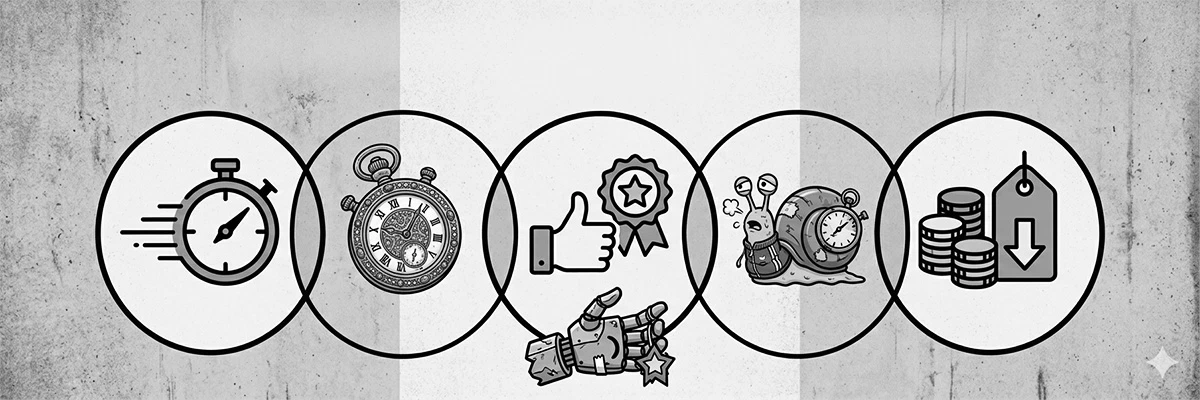
The old project triangle captures this in its simplest form: fast, high-quality, inexpensive, pick two. In that model, the boundaries appear clear and the choice appears singular.
Reality is far less orderly.
Businesses rarely sit down and consciously choose between competing priorities. More often, they attempt to pursue all of them at once. They plan for speed, quality, and efficiency simultaneously. They set targets and incentives that reward each of them in parallel, and then are surprised when teams become overstretched, quality begins to slip, timelines drift, and costs rise regardless.
The problem is not the trade-off itself. The problem is pretending that it does not exist.
Certain tensions appear repeatedly across organisations.
Growth and control are among the most familiar. Rapid expansion almost inevitably reduces oversight, while stronger control mechanisms often slow growth in the short term. Many businesses attempt to scale aggressively while preserving tight governance, and the result is often predictable: operational friction, bottlenecks, and internal chaos.
A similar tension exists between flexibility and efficiency. Flexible systems allow adaptation and responsiveness, but often at the expense of streamlined execution. Highly efficient systems, by contrast, tend to become rigid. Attempting to maximise both usually introduces friction rather than balance.
Innovation and stability create another recurring trade-off. Innovation disrupts routines, structures, and expectations. Stability creates predictability and confidence. When organisations attempt to maximise both simultaneously, they frequently end up with half-implemented initiatives and a workforce exhausted by constant change.
These tensions are natural.
Trade-offs are not simply the decisions made in a meeting room. They are the pressures that the system resolves over time. If leadership does not define them clearly, the organisation will resolve them on its own, often badly, inconsistently, and invisibly.
This is why trade-offs should not be understood as sacrifices. They are phases within a broader strategic sequence. Prioritising one variable does not eliminate the other. It merely shifts its position in time.
Choosing growth often means accepting a temporary reduction in control, with governance, discipline, and process becoming the next necessary step. Prioritising control may slow expansion initially, but it creates the conditions for more sustainable growth later.
The same principle applies to innovation and stability. Periods of disruption are often followed by deliberate stabilisation, after which the organisation becomes ready for the next cycle of change.
Seen this way, trade-offs are not losses. They are the order in which strategy unfolds.
The strongest organisations do not attempt to optimise everything at once. They understand which tension must be prioritised now, and which one must follow next.
That sequence is where strategy truly lives. Strategy is the choreography of priorities over time.