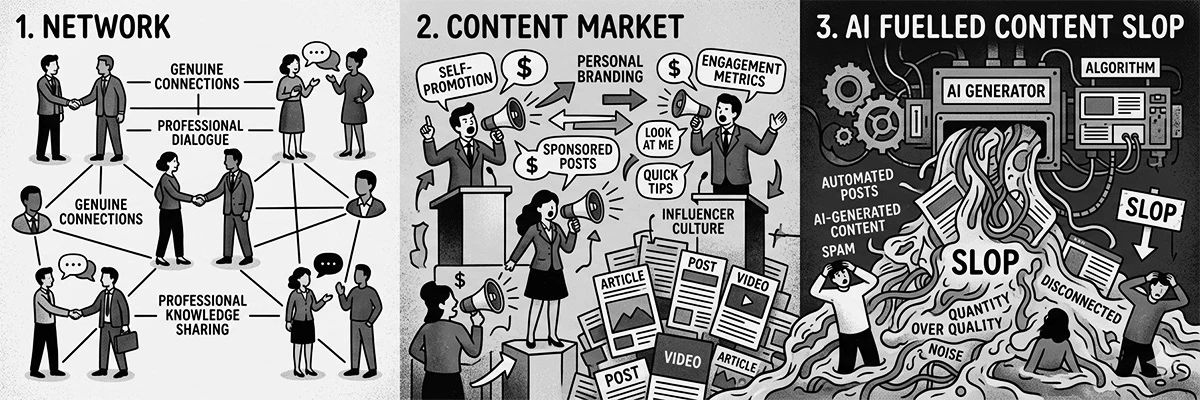
From Networking to Performance
ILLUSIONS
Some days LinkedIn feels less like a professional network and more like a travelling circus that simply forgot to pack up and leave town.
There is constant movement. Advice is dispensed at industrial scale. Certainty is manufactured on demand. Everyone appears busy performing competence. Yet genuine thinking, the slow and often uncomfortable process of forming an original view, seems increasingly rare.
The pattern is difficult to miss once you notice it. Someone shares a real observation grounded in experience. It resonates. Engagement follows. Within days, variations of the same idea begin to surface across the feed. Rewritten, reformatted, optimised for reach. AI tools accelerate the process further, allowing ideas to be harvested, diluted and redistributed faster than ever before.
Algorithms do not distinguish between lived insight and synthetic confidence. They reward what moves: activity, consistency, emotional packaging. In such an environment, originality becomes structurally disadvantaged. Reflection looks like inactivity. Silence looks like irrelevance.
The Incentive Problem
What was once a space for professional networking has gradually become something else. First it turned into a content marketing arena. Then into a performance economy where visibility itself became the currency. Now it risks evolving into a content farm ecosystem, populated by automated thought leadership and recycled conclusions presented as breakthroughs.
This is not necessarily the result of bad intentions. It is the predictable outcome of incentives. When reach is measurable and reputation appears scalable, behaviour adapts. People optimise for exposure rather than depth. Ideas are repackaged rather than developed. Experience is simulated rather than accumulated.
Convenience accelerates the shift. AI tools make production effortless. Templates make tone interchangeable. Trends provide ready-made topics. Every shortcut feels efficient. Over time, efficiency replaces originality as the dominant value. The feed fills with echoes.
Professional networking does not disappear in such systems. It simply retreats. Real conversations move into private messages, phone calls, small trusted circles. Public participation becomes theatre. Profiles begin to resemble curated resumes rather than living networks of mutual relevance.
When Original Thought Becomes Invisible
There is an uncomfortable irony in watching a platform designed to surface expertise gradually obscure it. More content is produced than ever before, yet meaningful signal becomes harder to detect. Participants begin to scroll faster, trust less, and remember little.
Platforms rarely collapse overnight. They erode through normalisation. What once felt artificial becomes standard practice. What once felt excessive becomes expected. Eventually, even those who sense the decline continue to participate because stepping away feels riskier than staying visible.
Perhaps this is simply the cost of digital scale. Or perhaps it is a reminder that professional credibility was never meant to be automated.
Original thought has always been slower, quieter and less predictable than performance. No algorithm will change that. The question is whether enough people still value it to keep practising it in public.
Many of these behavioural shifts are explored further in earlier Insights on organisational mentality and operational discipline.