FOUNDATIONS
Businesses are usually analysed through strategy, structure, capital, or market positioning. These elements matter, but they do not fully explain why some organisations adapt while others stall in similar conditions.
A quieter force often determines the trajectory: mentality.
The dominant mindset inside a company shapes how uncertainty is interpreted, how risk is distributed, and how decisions are prioritised. Over time, recurring behavioural patterns emerge. They are not rigid personality types but operational tendencies that become visible under pressure.
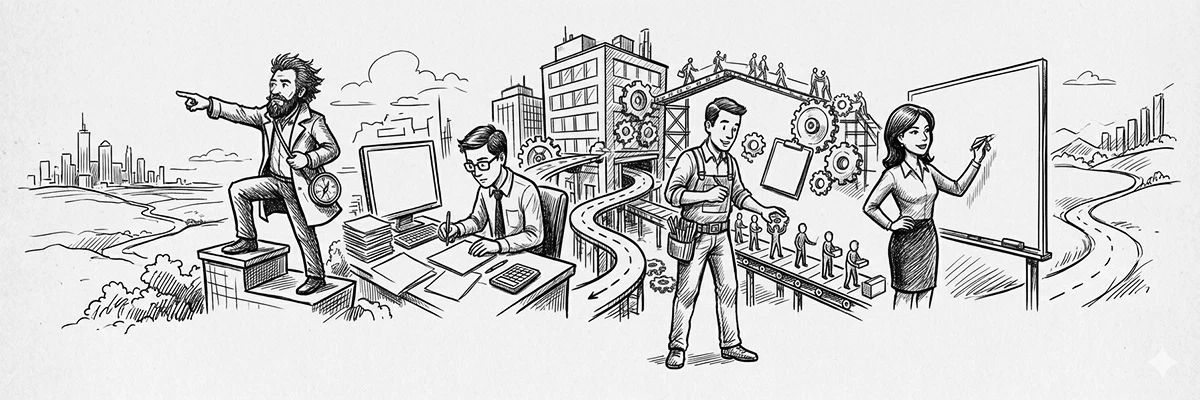
One common pattern is the Governor mentality. Control is central. Authority is closely guarded. External perspectives are treated cautiously, and delegation is limited. This mindset is extremely effective during early survival phases when discipline and financial prudence are essential. Yet as organisations grow, the same control mechanisms can slow responsiveness and narrow the range of acceptable options.
Equally influential is the Driver mentality, grounded in field experience and proven methods. These leaders stabilise execution when conditions are volatile. They know what works because they have seen failure first-hand. However, reliance on past success can make it difficult to recognise when the environment has fundamentally changed.
In contrast, the Student mentality approaches problems through frameworks and structured analysis. It often accelerates modernisation and introduces useful language for strategy and planning. At the same time, an overreliance on transferable models can underestimate the friction of real-world implementation.
Transactional environments frequently produce the Pusher mentality, where immediate turnover and cashflow dominate decision logic. Marketing investment, brand positioning, or capability building may be viewed as optional luxuries rather than structural necessities. This mindset protects liquidity but can gradually erode long-term competitiveness.
External intervention brings its own dynamic. The Expert mentality tends to prescribe solutions quickly in order to demonstrate value. Fresh perspective can unlock progress, yet insufficient contextual understanding may create friction with internal realities.
Another increasingly visible pattern is the Jumper mentality. Organisations driven by constant innovation impulses generate initiatives at high speed. Renewal energy is valuable, but without integration discipline it can fragment attention and exhaust teams.
Not all dominant mentalities constrain performance. Some enable balance.
The Architect mentality focuses on systems rather than isolated actions. It recognises leverage points, interdependencies, and sequencing. Instead of reacting to symptoms, it designs pathways for adaptation.
Alongside it operates the Custodian mentality, which protects continuity, institutional memory, and cultural stability. While sometimes perceived as conservative, this mindset ensures that change remains absorbable and does not destroy accumulated capability.
Difficulties arise when one mentality continues to dominate beyond the phase in which it was useful. A survival logic may persist during growth. Operational certainty may block renewal. Innovation enthusiasm may outpace execution capacity. In such situations, organisations do not necessarily lack intelligence or effort. They are constrained by a behavioural operating system that no longer fits their environment.
Meaningful mentality shifts rarely occur through intention alone. They often follow ownership transitions, structural branching, generational change, or periods of financial security that create space for curiosity. Occasionally they are triggered by discomfort strong enough to disrupt established patterns.
Understanding these dynamics does not provide simple answers. It does, however, offer a more realistic lens through which to interpret stalled initiatives, wasted momentum, or unexpected resilience.
Businesses move differently depending on how their leaders think. Recognising mentality patterns early can be the difference between activity that reassures and action that transforms.