CONSTRAINTS
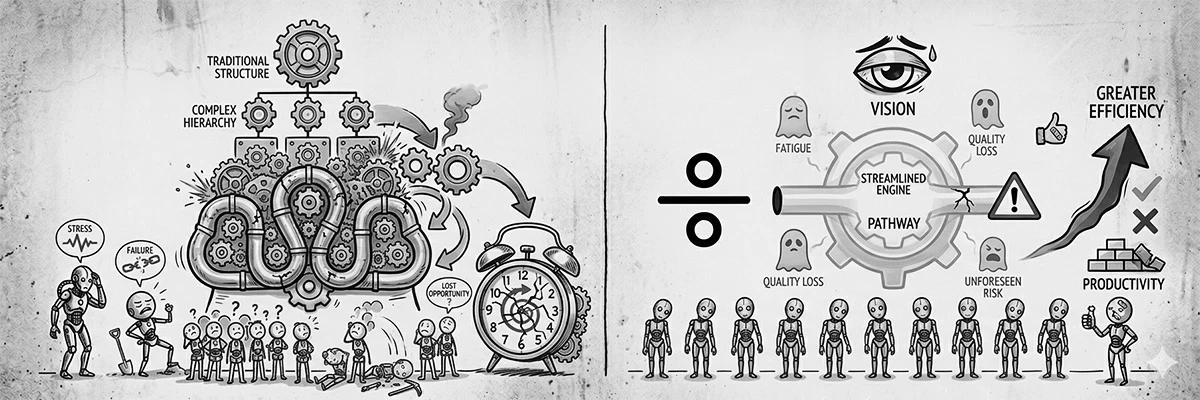
The management stack in business has always consisted of layers. From owners and boards to C-level executives, through various levels of middle management and down to junior staff and field personnel, organisations have traditionally grown vertically. Small companies may operate comfortably with only a couple of layers, while large multinationals can resemble towers, with a final decision-maker at the top and dozens of levels in between.
For a long time, this was seen as a natural sign of evolution. Businesses grew, expanded, hired more people, and added new layers of oversight, coordination, and decision-making. The path from solo entrepreneur in a basement to influential enterprise with tens of thousands of employees often followed a familiar vertical logic.
But now we are seeing a different pattern. Companies are beginning to go lateral. They are flattening.
In some cases, this is a deliberate redesign of how work moves through the organisation. In others, it is something far less strategic.
Not all companies are truly redesigning. Some are simply cutting managers and calling it agility. This is not merely anecdotal. Recent workforce surveys suggest that 41% of employees report reduced management layers, while 37% say they feel more directionless as a result. At the same time, industry forecasts suggest that by 2026, a growing number of businesses will use AI and automation to streamline structures and remove a significant share of middle-management roles.
Logic
The instinct behind flattening is understandable. In many organisations, hierarchy itself has become a source of friction. Too many layers can slow approvals, duplicate reporting, and create distance between leadership and the field. Reporting chains expand, decision cycles lengthen, and accountability becomes diffused across multiple levels. The desire to simplify is not wrong. The risk lies in mistaking the removal of hierarchy for the removal of complexity.
From one perspective, flattening is driven by automation and AI solutions. Data analysis, reporting, and process monitoring can now be executed faster and with fewer manual touchpoints. Certain layers that previously existed to consolidate information or produce reports may no longer be necessary.
From another perspective, it is simply structural and cost optimisation. If two layers overlap, they can be merged. One layer instead of two, operating at one and a half times the cost, appears more efficient on paper.
Outsourcing and delegation reinforce the same logic. Why keep entire structural units in-house when specialised providers or platforms can perform the function externally?
On paper, the advantages are clear.
Lower costs. Faster communication. Greater flexibility.
But the disadvantages are often less visible.
Hidden costs
Technology itself is not always cheap. AI and automation solutions require investment, training, oversight, and in many cases additional personnel to manage and validate outputs. Removing people without accounting for the systems needed to replace them can simply shift cost rather than reduce it.
The same applies to expertise. It is easy to say that automation can now handle legal, accounting, development, or marketing work. But when those people leave, expertise leaves with them. Systems can generate outputs. They cannot always replace judgement. And in most cases, specialists still need to remain in place to ensure that what is produced is accurate, feasible, and strategically sound.
The communication advantage can also prove illusory. Flattening is often presented as a way to speed up information flow. In practice, it can lengthen it.
Outsourcing, delegation, and lateral structures frequently introduce ownership gaps. Information becomes fragmented across providers, teams, and tools. Instead of simplifying the communication chain, the organisation creates more handover points and more ambiguity. It takes longer, not less time, to get a clear picture.
This is where flexibility itself can become an illusion. A smaller structure is not automatically a more flexible one. In some cases, it becomes more rigid.
Middle layers are not merely cost. They are often the organisation’s shock absorbers. They translate strategy into execution, problems into action, and signals into decisions. Remove too many layers and suddenly the CEO sees dashboards, the frontline sees chaos, and no one is left to translate between the two.
Flattening may reduce layers, but it can also remove the organisation’s ability to absorb friction. This becomes even more visible in span of control. Remove one layer and the layer above suddenly manages more people, more functions, more decisions, and more escalation points.
Communication may become faster in theory. But in practice, span of control widens. And wider spans often slow real decisions.
The result is not necessarily flatter leadership, but the rise of the megamanager: fewer people carrying more escalation points, more decisions, and less time to think.
Another cost is less visible, but no less significant. Flattening quietly removes career ladders. Where organisations once offered a visible progression from junior to manager to senior manager to director, the ladder can collapse into something much narrower: junior – senior – cliff edge. This creates retention problems, morale issues, and stagnation of ambition. People no longer see where they are going.
And then there is accountability. Flattening often leads to ownership diffusion. If functions are merged, outsourced, or increasingly AI-assisted, a critical question emerges: who actually owns the decision? When something goes wrong, the absence of a clear answer becomes a structural weakness.
For all its promised advantages, flattening often succeeds only when the hidden costs are understood and deliberately managed. Too often, however, corners are cut. And as we know, once corners are cut often enough, they become the new norm. So, perhaps, the real question is not whether companies are becoming flatter. Perhaps, the real question is whether, in some cases, they are simply becoming thinner: understaffed, overextended, and brittle rather than leaner, faster, and clearer.