ILLUSIONS
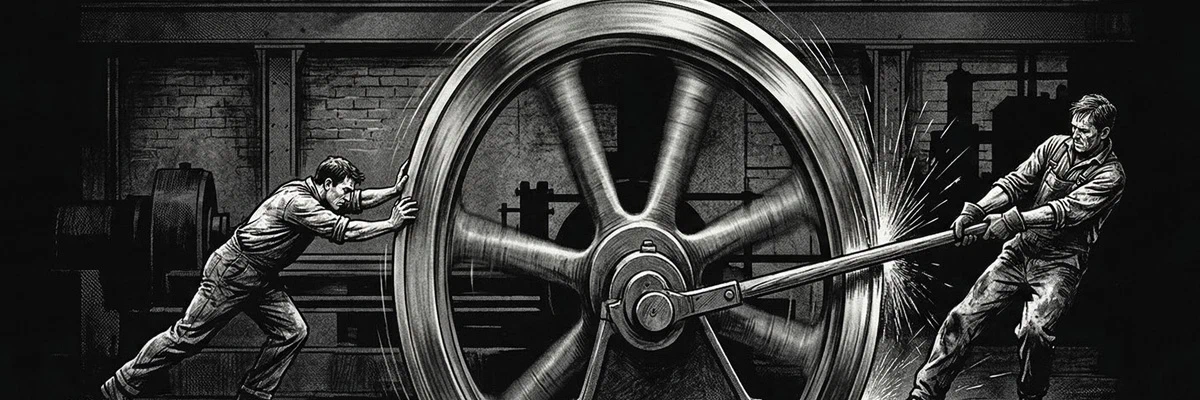
Sometimes organisations move a great deal.
Teams are restructured.
Costs are cut.
Offices are relocated.
New initiatives are launched.
From the inside, this feels like decisive leadership.
From the outside, the system often remains unchanged.
I call it ‘The imitation game’.
Individuals learn early how to appear busy.
Organisations do the same.
When real constraints feel too risky to confront, activity becomes performance.
- optimising details instead of addressing structural issues
- copying competitors instead of understanding customers
- reshuffling people instead of strengthening capability
- launching initiatives instead of making hard decisions
Movement becomes reassurance.
Crisis theatre
During downturns, visible action carries symbolic value.
In one case during a financial crisis, experienced field professionals were released while expatriate leadership positions were preserved.
The reasoning felt rational at the time:
- experience was expensive
- knowledge was assumed transferable
- the market was expected to supply replacements later
In reality, much of the expertise had been built through local adaptation rather than imported frameworks.
When the organisation later attempted to rebuild capability, the cost of relearning exceeded the savings.
The system had moved.
But not towards resilience.
Cost logic and competitive assumptions
In another crisis, senior managers with deep client relationships were let go under the assumption that competitors would do the same.
The expectation was simple:
Talent would circulate.
Cheaper replacements would be available.
Instead, some competitors chose a different path:
- temporary salary reductions
- unpaid leave arrangements
- delayed bonuses
- office consolidation
They prioritised loyalty and continuity.
Markets rarely move in synchrony.
Decisions based on assumed collective behaviour can expose organisations to unintended risk.
Why false movement happens
Several forces typically converge:
Leadership insecurity
Visible action signals control even when understanding is limited.
Financial panic
Cost reduction becomes the most measurable intervention.
Market misreading
Theory is mistaken for lived reality.
Organisational comfort
Smaller changes feel safer than structural ones.
Hierarchical pressure
Activity becomes a way to satisfy superiors rather than solve problems.
Signs your organisation may be experiencing false movement
- initiatives multiply but customer outcomes remain unchanged
- reporting and meetings increase while decision clarity decreases
- experienced capability is replaced faster than it is rebuilt
- cost reductions dominate discussion more than value creation
- teams feel busy yet struggle to explain what has fundamentally improved
- competitors’ actions influence strategy more than direct market insight
- structural constraints are acknowledged privately but avoided publicly
Recognising these patterns early can prevent energy from being consumed by motion that does not lead to progress.
The paradox of accidental discovery
Not all displacement activity is waste.
When people cannot influence major decisions, they often turn to smaller explorations.
Occasionally this leads to unexpected value:
- reconnecting with dormant contacts who become new clients
- discovering niche technologies that open new applications
- identifying overlooked operational improvements
These outcomes are rarely planned.
They emerge from curiosity operating within constrained systems.
Connecting movement to reality
The challenge for leadership is not to eliminate activity.
It is to distinguish between movement that relieves anxiety and movement that improves organisational fitness.
Real progress usually requires confronting uncomfortable truths:
- capability gaps
- market positioning errors
- cultural rigidity
- structural bottlenecks
These are harder to address than relocating an office or launching a programme.
Systems do not change because people are busy.
They change when effort is applied where it alters behaviour, capability or direction.
The hardest task in moments of pressure is not deciding to act.
It is deciding where action actually matters.