DIAGNOSIS
Or a few observations on a post-mortem of a recent SMM campaign.
Media weight only has meaning when the system receiving that weight is capable of converting it into something. Otherwise you’re simply pouring traffic into a broken funnel.
The late 1990s and early 2000s were certainly dominated in many FMCG categories by reach, frequency, GRPs/TRPs and media weight, especially television. The logic was essentially that sufficient reach and frequency would drive awareness and ultimately behaviour.
Then came the digital/content shift, with “Content is King” becoming one of the defining mantras of the 2000s and 2010s. Again, not a clean replacement. Media weight never disappeared. It simply acquired more channels. And that’s actually the interesting bit. We didn’t really move from Media weight to Content, we moved toward layers: Media weight + Content + Distribution + Engagement + Data + Algorithms. Yet some organisations still behave as though the first component can compensate for everything else.
Imagine the system as: Ad – Profile – Content – Engagement – Relationship – Conversion. The campaign is massively increasing the first variable. But the rest of the system is barely functioning. So what happens?
Ad to empty profile
The user arrives and finds:
- almost no content
- unrelated posts
- no coherent narrative
- no useful information
- no visible community
- no engagement
- unanswered comments
- unanswered followers
The campaign isn’t feeding a marketing system, it’s feeding a void. An empty profile is not a neutral destination. It communicates information. Visitors draw conclusions from what they see and from what they don’t see. Inactive accounts, unanswered comments and absent content are signals just as much as advertising impressions are.
What exactly are we measuring when we measure media weight?
Because 60 ads a day sounds impressive. But if 60 ads lead to an empty profile, you’ve simply created 60 opportunities for people to discover that nothing is there. The weight may actually be amplifying the weakness.
Someone looks at the platform and says: “We have dozens of creatives running.” But perhaps the ‘carousel campaigns’ have been decomposed by the platform into dozens of individual ad variants. Suddenly the dashboard reports enormous activity. Activity has become the evidence of activity. Not evidence of effectiveness.
The followers numbers are even more interesting
This is where I wouldn’t dismiss a few dozen follows as insignificant. They’re actually signals.
People have responded sufficiently to the advertising to say: “I want to see more from this account.” And then… Nothing. No acknowledgement. No reciprocal engagement. No content. No relationship. The organisation has generated an outcome and then failed to process it. That’s almost more interesting than getting no response. You have a working acquisition component attached to a non-functioning retention/engagement component.
The system is generating inputs faster than the organisation can absorb them. Which means the bottleneck isn’t media. It’s organisational readiness.
Does media weight still matter?
Yes, it does. But only inside a functioning system. If the proposition is strong, the audience is right, the creative is relevant, the landing environment supports the promise, the profile provides evidence, the organisation responds to engagement, and the conversion mechanism works, then more appropriate reach can absolutely matter. But media weight cannot compensate indefinitely for structural deficiencies elsewhere. In fact: Once the bottleneck moves somewhere else, adding more weight to the media side is simply adding pressure to the wrong part of the system.
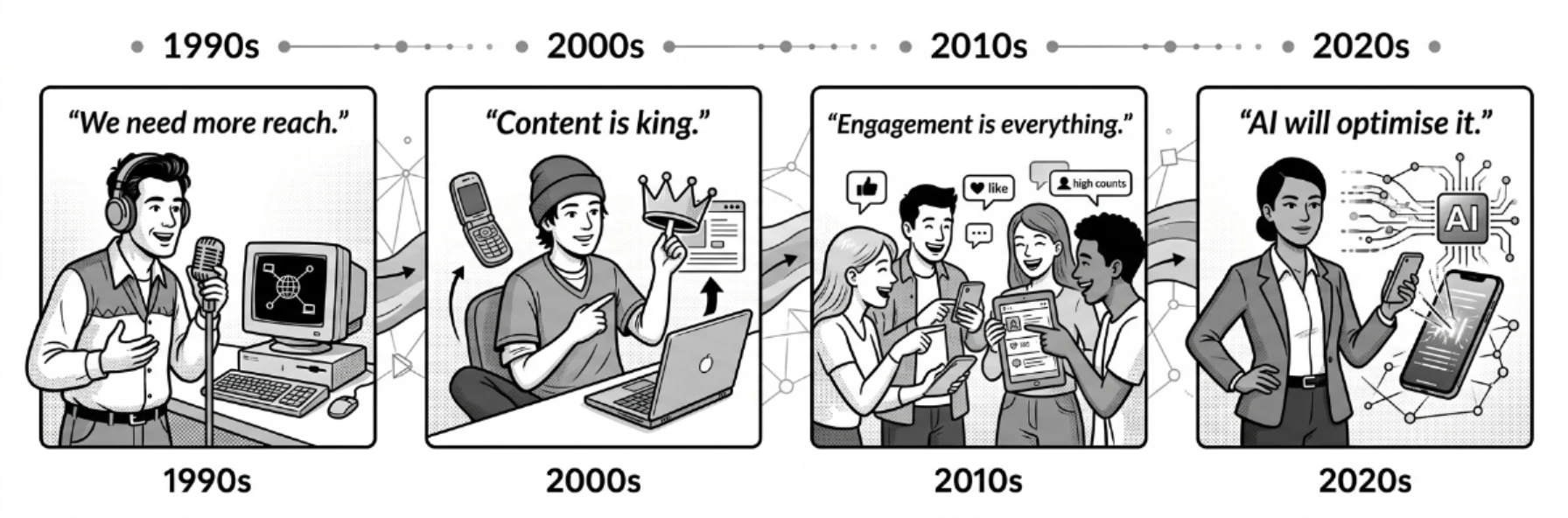
And there’s a wonderful progression available:
1990s:
“We need more reach.”
2000s:
“Content is king.”
2010s:
“Engagement is everything.”
2020s:
“AI will optimise it.”
Underneath each wave sits the same assumption: If we increase the visible input, the desired outcome will follow.
Sometimes it does. But only if the rest of the system is capable of receiving it. The problem isn’t primarily media weight. It’s that the campaign is violating a very basic commercial principle: Don’t create demand for something the customer cannot meaningfully buy. Or, simply: Don’t promote the product you are out of stock of.
The sequence is almost perverse
Advertising creates interest → interest creates intent → intent encounters absence → frustration appears → competitor becomes the available alternative.
The company isn’t merely wasting advertising money. It may be paying to send potential customers towards its competitors. That’s considerably worse. And this gives you a very nice distinction between media weight and market readiness. Media weight increases the pressure entering the system. If the rest of the system isn’t ready, the pressure doesn’t produce proportionally better results. It produces congestion, leakage, frustration or failure. The organisation thinks: “We need more awareness.” So it increases awareness. Then discovers: “We can’t convert awareness into anything.” The solution has created the next problem. Except here the next problem was entirely predictable. That’s the really important bit. The issue wasn’t that the campaign failed unexpectedly. The organisation had an inactive public-facing environment before pouring traffic into it.
Demand generation and demand absorption are parts of the same system. If you generate demand without preparing the organisation to absorb it, you haven’t created growth. You’ve created a queue.
A queue with adverse outcomes.
See also: