ILLUSIONS
The Illusion of Finished Solutions
Businesses speak the language of solutions.
We solve customer acquisition, automate reporting, implement a new CRM, introduce AI, redesign our organisational structure. Every success is presented as a destination, as though one more problem has been permanently removed from the world.
Reality rarely works that way.
Years ago, we launched a programme that collected proof of purchase from consumers. Long before loyalty cards and modern analytics became commonplace, customers submitted their shop receipts and, in return, we built a remarkably detailed picture of what they actually bought. Within months we had accumulated an extraordinary amount of data. Everyone was delighted until a simple question emerged: “What do we do with all of it?”
The technology to collect the information already existed. The technology to understand it did not. The data sat there, full of potential, waiting nearly a decade for analytical tools to mature. By the time meaningful insight became possible, the question had often moved on.
At the time, it felt like an unfortunate limitation. Looking back, it was something much more interesting. It revealed a pattern.
How Organisations Develop New Capabilities
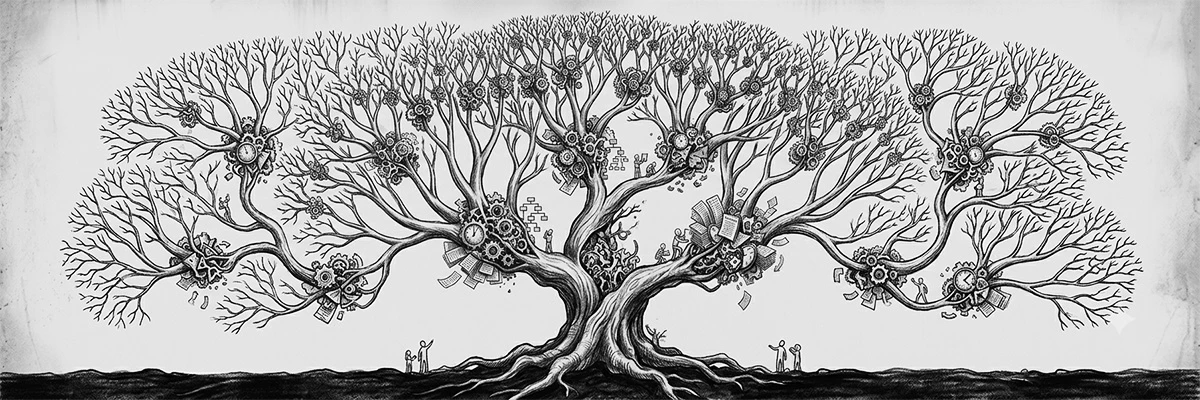
Organisations often develop new capabilities in waves. First, they learn how to observe. Years later, they learn how to interpret. Later still, they learn how to govern what they’ve built. Each stage feels like progress. Each stage also reveals a new class of problems that couldn’t even be seen before.
When we learned how to collect customer data, analysis became the bottleneck. When analysis became affordable, decision-making became the bottleneck. As AI accelerates interpretation, governance increasingly becomes the bottleneck.
Every capability changes the landscape.
This is why so many technological revolutions disappoint those expecting final answers. They don’t remove complexity. They relocate it.
Reality Always Answers Back
Helmuth von Moltke famously observed that no plan survives first contact with the enemy. The quote has long outgrown its military origins.
Every strategy, every organisational chart, every business model is simply our best description of reality before reality has had a chance to answer back.
The first collision exposes assumptions. The second reveals constraints. The third creates entirely new questions.
Progress isn’t linear. It’s generative.
Every Solution Changes the Landscape
Every successful solution expands the space of what becomes possible. It also expands the space of what can go wrong, what must be governed, and what must now be understood. We often treat solutions as destinations rather than temporary agreements with reality. Perhaps that’s why businesses chase best practice as though perfection were a permanent state.
But there is no such thing as perfection. It’s a process, not a result. A solution remains “perfect” only for as long as the landscape around it remains unchanged.
Markets move. Technology evolves. Customers adapt. Competitors respond. Regulations appear. People find unexpected ways to use systems. Yesterday’s optimisation quietly becomes tomorrow’s legacy.
Murphy’s Law captures the same truth from another angle. “Anything that can go wrong, will” is often treated as pessimism. In reality, it reflects something much more practical. Given enough time, every hidden assumption will eventually encounter reality.
Reality is simply an exceptionally patient tester.
Perhaps this explains why experienced operators rarely celebrate the end of a project. They know implementation is not the finish line. It is the moment reality begins participating. The organisation hasn’t eliminated its problems. It has earned better ones.
A company with no customer data dreams of having too much data. A company with too much data dreams of understanding it. A company that understands it discovers governance, ethics, accountability, and trust.
Each achievement unlocks another layer. You don’t finish the game. You unlock the next level.
Every new level reveals a landscape invisible from the previous one. Progress doesn’t end complexity. It changes its shape.
See also: Borrowed Certainty, Where to Start When Something Feels Wrong, and AI Agents Need Boundaries