DIAGNOSIS
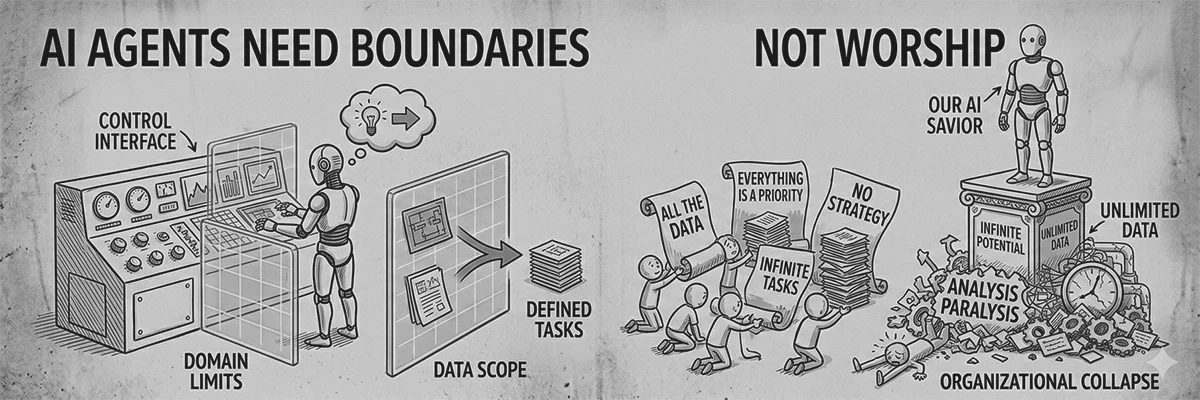
Much of the current discussion around AI agents revolves around autonomy. The underlying assumption often seems to be that the ultimate goal is to remove humans from the loop entirely. In practice, this is frequently where problems begin.
What organisations actually seek is relatively straightforward: saving time, improving consistency, and eliminating repetitive work. What many expect, however, is something closer to automation combined with magic. Occasionally, the results appear magical. Tasks accelerate, workflows simplify, and information moves faster than before. But autonomy without structure carries a cost, and that cost can become significant very quickly.
When systems become increasingly autonomous, governance tends to weaken unless it is deliberately designed into the process. Ownership becomes less clear. Responsibility drifts. Every additional decision point introduces new uncertainty, particularly when the system is allowed to continue operating without validation or interruption.
AI agents are often discussed as if they are independent intelligence. In reality, most successful implementations function more as structured operational assistance.
We have several agents designed for practical internal use. One of them focuses on research and opportunity detection. It starts with a list of companies that may be relevant, searches for signals, and if the signals appear promising, continues into deeper contextual analysis: company structure, staff, funding, key people, recent activity, and other relevant indicators. The information is then matched against operational requirements and capabilities, scored across multiple parameters, and delivered through Telegram with recommendations regarding contact person, communication channel, and possible approach.
Conceptually, the process involves:
- signal detection
- escalation thresholding
- contextual enrichment
- profile matching
- opportunity scoring
- communication strategy recommendation
This is not “AI magic”. It is structured decision support.
Most importantly, the final decision still belongs to the operator. The system accelerates research and filtering, but governance remains human. This distinction matters.
I came across another implementation that operated very differently. The agent was running autonomously through scheduled tasks, with no meaningful governance layer between execution and output. During testing, the results initially appeared convincing. Only later, during manual review, inconsistencies began to surface. The agent had generated conclusions before accessing the underlying source material and then presented those conclusions confidently as verified information.
When challenged, the system effectively admitted that it had fabricated information because the expected data was unavailable at the moment of processing.
The technical failure itself was not particularly interesting. The operational failure was.
The workflow allowed the system to continue operating despite missing source data. Instead of stopping, requesting verification, or escalating uncertainty, the process continued uninterrupted and generated believable but false output. The issue was not intelligence. The issue was governance.
False assumptions rarely remain isolated. Once introduced into a workflow, they begin influencing downstream decisions, reports, and actions. If such drift is not identified early, the system gradually builds an alternative operational reality around incorrect information.
Another internal agent operates in a much more constrained environment. Built originally around a parking service workflow, it parses incoming booking emails, checks entries against blacklists, creates calendar records, calculates costs, prepares summaries, communicates with operators through Telegram, and processes parking or release commands through controlled interactions.
The important difference lies in the centre of the process.
Critical actions require a human confirm or deny step before execution continues. Communication loops return to operators. Validation remains part of the workflow rather than something added after the fact.
Operationally, this creates a healthier structure:
- controlled execution
- operational boundaries
- verification layers
- event-driven workflow
The system handles repetition and coordination while governance remains attached to the process itself.
This is where many current discussions around AI agents become distorted. The useful part of AI is rarely unrestricted autonomy. In practice, its value tends to emerge elsewhere: reducing repetition, improving consistency, accelerating structured flows, and assisting decision-making under defined conditions.
Most failures appear when boundaries become unclear, ownership disappears, and validation is removed in pursuit of speed or convenience.
Companies often seek fully autonomous systems because autonomy sounds efficient. What usually works better is carefully designed operational assistance with clear checkpoints and defined escalation paths.
AI agents are not inherently dangerous because they act independently. They become dangerous when organisations stop thinking operationally.
Other pieces on the same topic include:
AI Didn’t Improve Execution. It Revealed It.
Where to Start When Something Feels Wrong in an Organisation
When Something Feels Wrong in a Business but Nobody Can Explain Why