DIAGNOSIS
When something feels wrong in an organisation, the visible problems are rarely the cause. They are symptoms.
Like in medicine, symptoms are expressions of an underlying condition. They can be treated, managed, or temporarily removed, but unless the cause is addressed, they tend to return. Often in a more complex form.
Organisations fall into this pattern easily. They fix what is visible, measurable, and urgent. The surface improves. The system does not. Over time, the same issues reappear, sometimes in different forms, sometimes with greater intensity.
Progress becomes difficult to distinguish from activity.
Where to Begin
It is tempting to start with strategy. In practice, strategy is rarely the immediate issue unless it is fundamentally flawed. A more reliable starting point is signal.
What is actually happening inside the organisation, as opposed to what is reported or assumed. Before anything else, the system has to be observed.
A Simple Lens
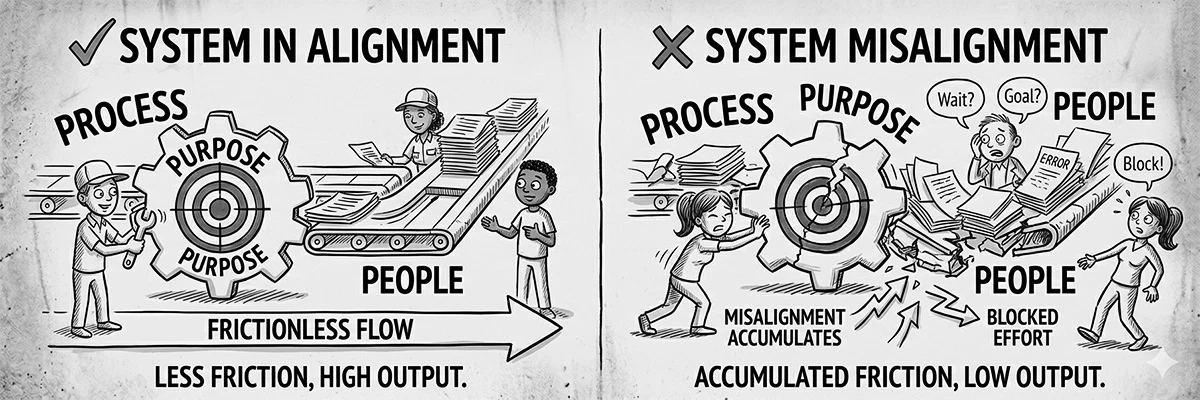
A useful way to approach this is through three elements:
Process — how work moves
Purpose — what the system is trying to achieve
People — who drives or shapes outcomes
When these align, organisations tend to operate with less friction. When they do not, misalignment begins to accumulate.
Observing the Flow
The first step is to understand how work actually flows. Not as it is documented, but as it occurs in practice.
Where does it slow down?
Where does it repeat?
Where does it stop entirely?
This is where the first meaningful signals appear.
Mapping Reality
Formal structures rarely reflect how decisions are made. It is more useful to map:
- key processes
- actual objectives
- decision-makers
- influencers
These are the points where the system can either move or stall.
Clarifying Purpose
Most organisations operate with two versions of purpose:
- the stated one
- the one that actually drives behaviour
If these diverge, the system compensates. Work increases, clarity decreases, and effort becomes misdirected. Understanding the real objective is essential before any structural change is made.
Following the Signals
Signals rarely present themselves clearly in one place. They have to be collected.
This involves listening to people, tracing information flows, and comparing accounts across different parts of the organisation. Consistency is more informative than individual statements. So are contradictions.
Locating the Constraint
At a certain point, patterns begin to converge. That convergence usually indicates a constraint. It may appear as delay, confusion, resistance, or overload, but these are expressions rather than causes. The underlying issue is typically structural.
The Nature of Bottlenecks
Despite appearances, most bottlenecks are not technical. They are human. They emerge from:
- unclear communication
- fragmented information flow
- ambiguous roles
- overlapping responsibilities
- weak ownership
- psychological factors such as ego or fear
Technical issues tend to reflect these conditions. They are rarely the origin of them.
On Systems and Tools
There is a growing tendency to attribute failure to tools. This is particularly visible in discussions around AI. In many cases, the issue is not the system itself, but how it has been introduced and structured. Without governance, ownership, or clear process, any system will produce inconsistent outcomes. AI simply makes those inconsistencies more visible, and often faster.
Testing Assumptions
Before any intervention, assumptions need to be tested. Small adjustments are often more revealing than large changes. They show whether the identified constraint behaves as expected.
Adjusting the Structure
The objective is not to intervene continuously, but to allow the system to function without constant correction. This usually requires:
- clarifying ownership
- simplifying processes
- removing unnecessary steps
- aligning incentives
A well-designed adjustment reduces effort. A poorly designed one redistributes it.
A Final Observation
Many organisations respond to friction by adding resources. More people. More tools. More activity. In practice, this often increases complexity without resolving the underlying issue. In many cases, the system does not require expansion. It requires the removal of constraints.
The patterns described above tend to converge around a small number of structural issues. In practice, they usually appear as distorted signals, unclear ownership, or hidden constraints in the flow of work. Addressing them rarely requires more tools, but a clearer structure.