DIAGNOSIS
Organisations are currently approaching AI in two distinct ways.
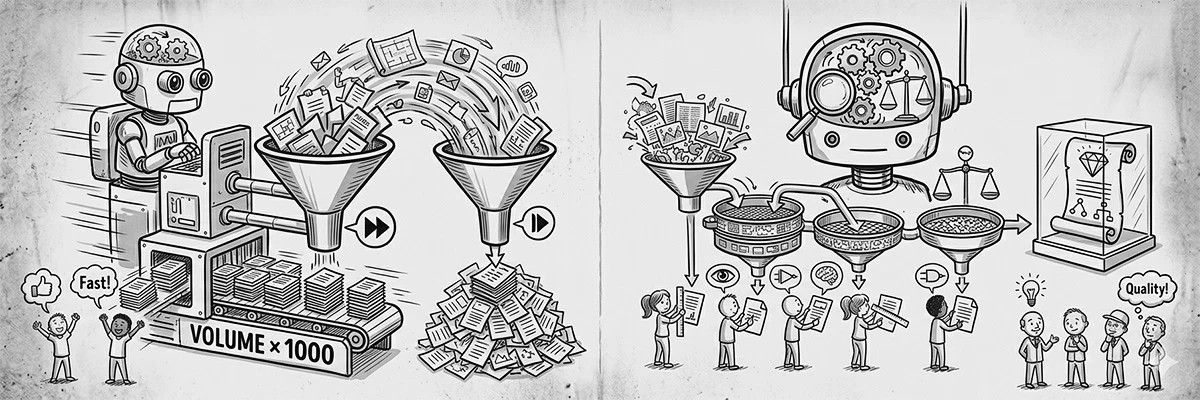
One approach optimises for speed, volume, and automation. The other prioritises control, signal, and decision quality. At first glance, both appear equally valid. In practice, they lead to very different outcomes.
We ran a simple internal exercise to explore this.
The task was to build an intelligence agent that monitors companies of interest across multiple channels. One proposal suggested running the agent twice a day, fully automated, going several levels deep into research. The alternative approach suggested running it twice a week, with deliberate pauses for review between changing depth stages.
The outcome was revealing.
The resulting data was effectively the same. The cost differed by a factor of seven. More importantly, the second approach retained control over the process, while the first created a continuous flow of output that required constant interpretation.
The system did not fail. The assumptions did.
Two ideas collapsed almost immediately: that freshness equals value, and that automation equals efficiency.
The first approach optimised for activity. It prioritised more data, more frequently, with greater depth. The second optimised for usefulness, focusing on relevant data at the right moment, with clear ownership of interpretation.
The tension surfaces
AI performed exactly as instructed. It simply executed the wrong priorities with precision.
This is where the tension begins to surface inside organisations.
AI does not introduce new problems. It amplifies existing ones.
Work becomes faster, but not necessarily better. Processes expand, but do not always improve. In many cases, duplication increases, outputs begin to conflict, and ownership becomes unclear. Activity rises, but accountability weakens.
One of the most subtle shifts is behavioural.
Responsibility begins to dissolve. Decisions are no longer clearly owned, but instead supported or justified through generated output. The phrase “the model said so” becomes a convenient anchor. Not as a deliberate deflection, but as a gradual shift in how responsibility is perceived.
AI, in this sense, becomes a shield.
At the same time, it produces something else extremely efficiently: convincing output.
Reports become cleaner. Summaries become structured. Arguments appear more complete. The problem is not that they are entirely incorrect. The problem is that they are credible.
There was a recent case in which a public spokesperson supported a position using four quotations. Only one was accurate. Two were loosely paraphrased. One was derived from commentary about the author rather than the author themselves. The output appeared coherent. It simply did not reflect reality.
This is not a technological failure. It is a behavioural one.
Execution layers
Many organisations are still using AI as an advanced search tool or a content generator. Few have built structured workflows around it. Fewer still have defined where automation is appropriate, where control is necessary, and where human judgement remains essential.
Without this, AI does not improve execution. It accelerates confusion.
The issue does not sit in strategy, nor in the tools themselves. It sits in the execution layer.
People are overloaded. Ownership is unclear. Processes are not designed to operate at the speed the tools now enable. The system compensates by producing more output, creating the appearance of progress without necessarily improving outcomes.
AI does not fix weak systems. It exposes them.
And if the system has not learned how to think, structure, and decide, it will simply produce better-looking mistakes at a faster pace.
In practice, these patterns rarely require more tools. They require clearer structure. Most failures around AI integration come down to signal distortion, unclear decision ownership, and overloaded execution layers.
When outputs look correct but reflect the wrong reality, the issue is not data — it is how information is filtered and interpreted.
AI increases the number of decisions. Without clear ownership, it also reduces accountability.
Automation accelerates work, but it also exposes where flow is already broken.