CONSTRAINTS
Not every opportunity can be absorbed within an established system. This is where strategy often collides with operational reality.
An organisation may identify a compelling adjacent opportunity, a new initiative, or a transformation project that appears strategically sound. On paper, the case may be convincing. The demand exists, the logic is clear, and the ambition is justified. And yet the initiative still fails. Not because the strategy was wrong, but because the system was unable to carry its weight.
Every new initiative requires an alloy of resources, knowledge, funding, and understanding. People, expertise, time, equipment, reporting lines, and decision rights must combine in a way that allows the work to move. Strategy may provide the direction, but execution depends on whether the organisation can support the load.
A common failure pattern is the internal shortcut.
In the name of speed and cost minimisation, leadership assigns responsibility to an existing team member. The choice appears rational. The person has some technical background, they are already inside the business, and no additional expenditure is required.
What is often missing is actual capability. The individual may not possess the necessary experience, domain understanding, or authority to move the initiative forward. The project slows, confusion accumulates, and momentum disappears. Eventually, management recognises that the work is not progressing, and the initiative is cancelled.
By then, the cost is no longer theoretical. Time has been lost. Internal confidence has been damaged. The assigned individual may no longer fit cleanly back into their previous role, which in some cases has already been backfilled.
The opposite failure pattern is equally common.
The organisation begins an external search, but instead of recruiting for capability and growth potential, it pursues an impossible ideal: a candidate with an MBA, twenty years of experience, the exact industry background, recent hands-on delivery in the same function, and preferably still early in their career.
This search can continue for months. The pursuit of a perfect fit often becomes a delay mechanism disguised as quality control. In reality, a 100 percent fit rarely exists.
A stronger approach is to recruit for meaningful alignment rather than perfection. A candidate who covers 65 to 80 percent of the requirements often provides the better outcome. This allows both the individual and the organisation to grow into the role together, while significantly reducing the time lost to prolonged search cycles.
This is where execution capacity becomes visible.
Before moving into a new initiative, an organisation must ask a simpler set of questions:
Do we have the right people?
Are they appropriately matched to the task?
Do we possess the necessary knowledge and experience?
Is there sufficient funding for space, equipment, and wages?
Do we have the structural capacity to support the work?
These questions are operational, but they are strategic in consequence.
Some organisations possess the necessary resources and still fail. Capacity on paper does not automatically translate into readiness in practice. Teams may already be operating near saturation, key functions may be absorbed by existing priorities, and the organisation may still be digesting previous changes. In such cases, the question is no longer whether the business can do it, but whether it can do it now. Timing becomes as important as capability.
An initiative introduced into a system that is already operating at full load rarely fails immediately. More often, it degrades gradually through delayed decisions, reduced standards, communication breakdowns, and rising frustration. That is often the first sign that the organisation has moved beyond its absorption threshold.
Another failure pattern appears when organisations attempt to build innovation on top of existing roles.
A capable internal individual is appointed to lead the initiative while still retaining their previous responsibilities. What begins as an efficient use of internal talent quickly becomes a conflict of priorities.
Pressure builds from multiple directions. Existing responsibilities remain, new expectations are introduced, and both roles begin to compete for time, attention, and decision quality.
In these situations, failure rarely appears as an immediate collapse. More often, it emerges gradually through overload, delayed decisions, and declining standards across both areas.
Even when the person proves to be the right fit for the new function, a second challenge emerges. Their previous responsibilities must be redistributed. Someone else must step into the original role, either fully or partially, and this creates a chain of secondary decisions.
Who is capable of stepping up?
Is that individual appropriately matched to the task?
What happens to the role they are vacating?
The friction moves down the structure. At some point, the organisation must decide where to introduce external support, not necessarily for the new initiative itself, but to stabilise the existing system around it.
This is where many businesses underestimate the true cost of innovation.
The initiative does not only require capability at the point of creation. It requires structural support across the system. And sometimes one person is not enough.
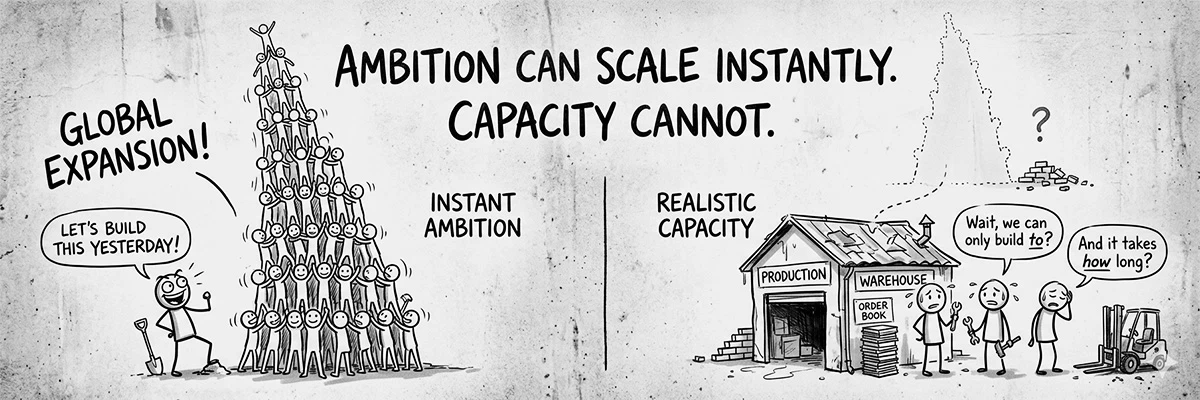
Certain initiatives require a crew, infrastructure, new processes, and dedicated operational support. For small businesses this is often impossible to absorb internally, and even medium-sized organisations can struggle when the system is already operating near capacity. This is why even strong strategies fail when organisations attempt to move faster than their own absorption capacity.
The system simply cannot metabolise that much change simultaneously. Execution fails long before strategy does.
The strongest organisations understand not only what they want to achieve, but how much change they can realistically carry at any given time. Because ambition can scale instantly. Capacity cannot.