DIAGNOSIS
When businesses struggle, the instinct is usually to reach for structured solutions.
New campaigns.
New channels.
New systems.
New strategic frameworks.
Sometimes all of this is implemented carefully.
And still, very little changes.
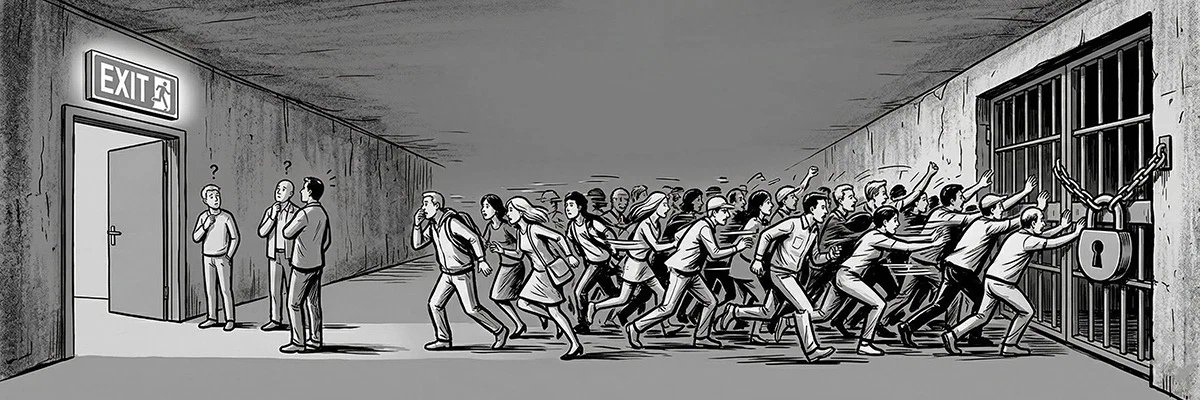
Because the real leverage was never in the plan.
It was in a small opportunity everyone overlooked.
Searching with heavy machinery
In one situation I observed, a business under pressure explored a range of calculated options.
Digital expansion.
Promotional redesign.
Performance tracking improvements.
Each initiative was logical.
Each required time, budget and coordination.
Results remained marginal.
The organisation was searching for gold with heavy machinery.
The overlooked flake
What eventually worked was something much simpler.
A small shift in messaging.
A reframing of a perceived disadvantage — distance and timing — into a reason to continue the journey.
“Drive one more mile and feel at home.”
Speed became advantage.
Delay became anticipation.
A weakness became a filter for the right customers.
Traffic patterns changed within days.
Systems move through leverage points
Businesses rarely transform because of grand initiatives alone.
They move when small adjustments align with how the system actually behaves.
Customer habits.
Physical environment.
Emotional triggers.
Operational friction.
These elements are difficult to capture in structured analysis.
They become visible through observation.
Leverage points are often modest.
Their effects are not.
Instinct as compressed experience
Such moments are sometimes described as intuition.
In reality they are the product of accumulated pattern recognition.
Experience allows some operators to notice where effort produces disproportionate impact.
This is not the opposite of strategy.
It is strategy operating closer to reality.
The door that opens
When a leverage point works, momentum returns.
Confidence improves.
Pressure eases.
Options expand.
A door opens.
At that moment leadership faces a decision.
The organisation can:
- pivot and redesign parts of the system
- institutionalise the insight
- invest where traction appeared
- or simply enjoy the temporary relief and continue as before
The gold flake does not determine the outcome.
Leadership response does.
Speed must be matched by awareness
Modern organisations are becoming faster at execution.
Technology accelerates analysis, coordination and communication.
But speed without situational awareness creates fragility.
Momentum created by small breakthroughs is perishable.
Competitors adapt.
Customer behaviour stabilises.
Operational constraints reassert themselves.
Recognising when to move — and how far — becomes critical.
Thinking must remain embodied in reality
Structured plans, digital dashboards and AI-generated insights can all support decision-making.
They cannot replace direct engagement with how the business actually functions.
Real leverage is often discovered:
- in customer interactions
- in frontline observation
- in physical environments
- in informal feedback loops
Systems thinking becomes valuable only when it remains grounded.
Consistent patterns across situations
These dynamics appear repeatedly:
- bottlenecks slow movement until pressure forces adaptation
- operational discipline determines whether momentum is sustained
- technological acceleration increases the cost of poor judgement
- small leverage points create windows for change
Different situations.
Similar underlying mechanics.
Success does not always arrive as a fully designed strategy.
Sometimes it appears as a small opening.
Companies that understand how systems move can recognise these moments and act.
Those that hesitate often discover that the opportunity has quietly passed.